You may be hearing quite a bit about Trump Accounts.
Maybe you’ve heard that the government is putting $1,000 into an account for children. Or have you heard that parents and grandparents can contribute? Or maybe you’ve heard that employers can contribute for their employees.
There is a lot of information floating around, and like most things involving the tax code, it’s not quite as simple as the headline makes it sound. So let’s dig into this.
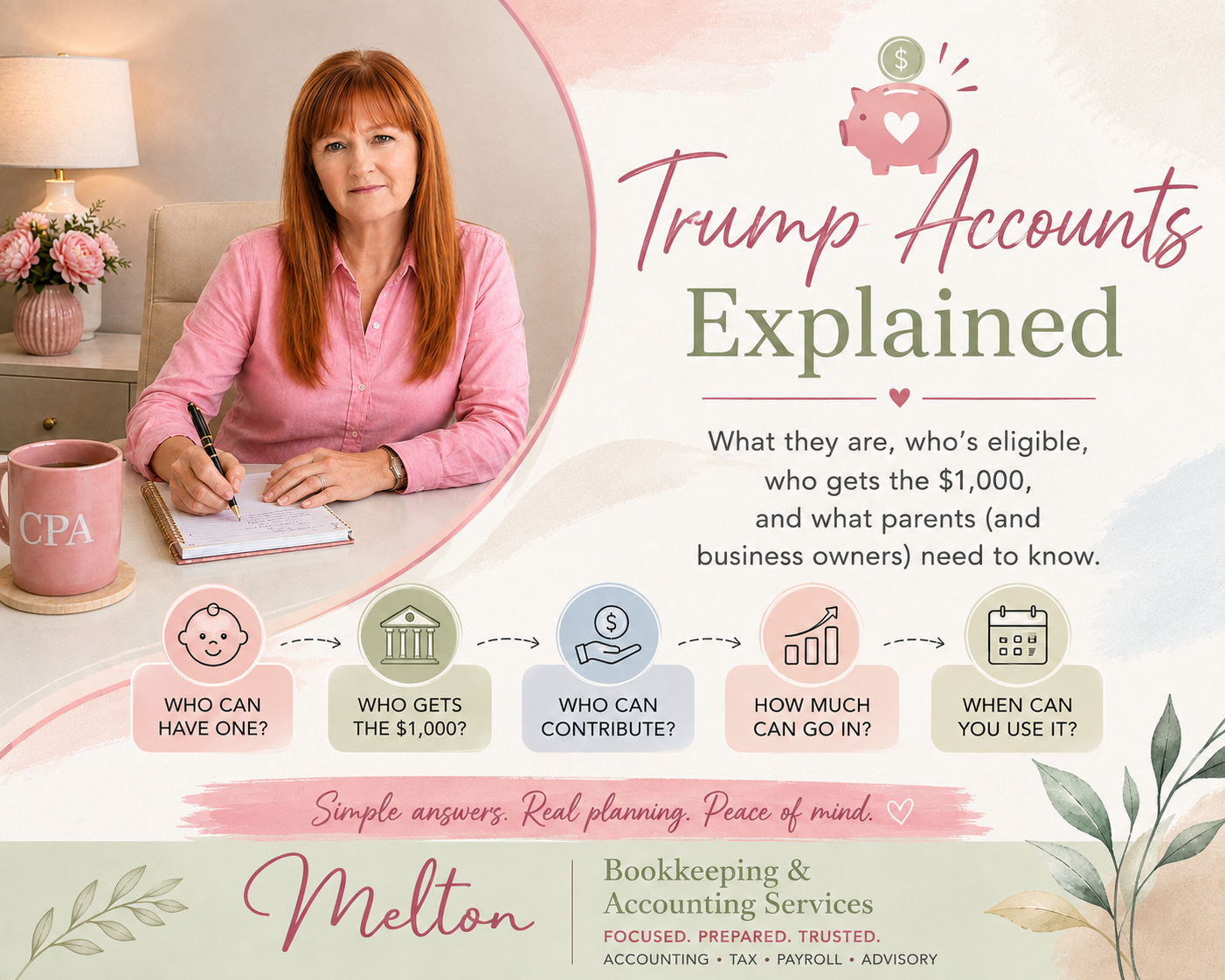
A Trump Account is a new type of individual retirement account (IRA) for children. Eligible children can have an account established for them, and certain children born from 2025 through 2028 may also qualify for a one-time $1,000 federal government contribution.
Those are two separate things, and that’s probably the most important point to understand.
Trump Accounts at a Glance
| Question | Quick Answer |
| What is a Trump Account? | A special type of IRA established for a child |
| Who can have one? | Generally, an eligible child under age 18 with a valid Social Security number |
| Who gets the $1,000? | Certain qualifying U.S. citizen children born January 1, 2025 through December 31, 2028 |
| Does the child need earned income? | No, not during the special growth period |
| Can parents contribute? | Yes |
| Can grandparents contribute? | Yes |
| Can employers contribute? | Yes, subject to special rules |
| What is the general contribution limit? | Generally $5,000 per year for 2026 and 2027 for contributions that are subject to the limit |
| Can the money generally be withdrawn while the child is young? | No, except in limited circumstances |
Now let’s break all of that down.
What Is a Trump Account?
Basically, a Trump Account is a new type of IRA for children.
Think of it as a long-term investment account that gets started while the child is young.
The account belongs to the child, but because we’re talking about minors, a parent or another authorized person generally gets the account started for them.
And no, this isn’t an account that Mom and Dad can dip into when they need money for school clothes or a new set of tires.
This money is intended to stay invested for the child’s future.
Who Is Eligible for a Trump Account?
Here’s where I’ve already seen some confusion.
You may have heard:
“Trump Accounts are for children born between 2025 and 2028.”
That’s not quite right. A child does not have to be born between 2025 and 2028 to have a Trump Account.
A Trump account can be established for a child who is under age 18 at the end of the year the election is made, has a valid Social Security number, and has not already had an initial Trump Account election made for them.
So an older child may still qualify for an account.
The 2025–2028 dates are important for something different, the government’s pilot-program one-time $1,000 contribution.
Who Qualifies for the $1,000 Trump Account Contribution?
This is the part that has probably received the most attention.
The federal government will make a one-time $1,000 contribution for certain qualifying children.
To qualify, the child generally must be a U.S. citizen with a valid Social Security number and must have been born between January 1, 2025 and December 31, 2028.
So let’s make this really simple. If your child was born in 2026 they may qualify for a Trump Account and the $1,000 government contribution.
If your child was born in 2018 they may still qualify for a Trump Account, but they wouldn’t qualify for the $1,000 government contribution.
Those are two separate rules. That’s probably the biggest thing I want people to understand.
Does the Government Put $1,000 in the Trump Account Every Year?
No. The $1,000 government contribution is a one-time contribution.
If a qualifying child receives the $1,000 federal pilot-program contribution, the government does not contribute another $1,000 the following year.
For example, a qualifying child born in 2026 may receive one $1,000 government contribution to the child’s Trump Account—not $1,000 in 2026, another $1,000 in 2027, another in 2028, and so on.
Parents, grandparents, employers and others may be able to continue making additional contributions to the account, subject to the applicable rules and contribution limits. But those contributions are separate from the government’s one-time $1,000 contribution.
Is There a Deadline to Open a Trump Account?
The answer is sort of. For the account itself, the election generally needs to be made while the child is still eligible under the rules for establishing an initial Trump Account.
For the $1,000 government contribution, the important date is the child’s birth date. The child generally needs to have been born between January 1, 2025 and December 31, 2028.
So don’t confuse that four-year window for the government money with who can actually have a Trump Account.
Does a Child Need a Job to Have a Trump Account?
The answer is no. This is a big difference from the normal IRA rules many of us are used to. During the child’s special growth period, contributions can generally be made even if the child has no earned income.
In other words, your 5-year-old doesn’t need to get a job before Grandma can contribute to the account.
Who Can Contribute to a Trump Account?
This is where it gets interesting.
Money can potentially come from several places. Parents can contribute. Grandparents can contribute. Other family members and friends may be able to contribute. Employers may also be able to contribute. There can even be certain government and charitable contributions.
But different types of contributions have different rules. That’s important when we start talking about contribution limits.
What Is the Trump Account Contribution Limit?
Generally, during the child’s special growth period, there is a $5,000 aggregate annual contribution limit per child/account beneficiary for 2026 and 2027 for regular contributions subject to the limit.
But, and here’s where the tax rules start doing what tax rules do, not every contribution counts toward that $5,000.
For example, the government’s special $1,000 contribution doesn’t count against it. Certain government and charitable contributions may not count against it either.
Employer contributions generally do count against the $5,000 annual contribution limit.
So when you hear: “The Trump Account limit is $5,000.” The better answer is: “Usually the Trump Account contribution limit is $5,000, but it depends on where the money came from.”
Welcome to the tax code.
Can Grandparents Contribute to a Trump Account?
Yes, they potentially can. And I think this may end up being one of the more popular uses of these accounts. Instead of another toy at Christmas or another gift that gets forgotten six months later, grandparents may decide to put money into a grandchild’s Trump Account.
Parents, grandparents and other people can potentially contribute as long as the applicable contribution rules and annual limits are followed.
Are Trump Account Contributions Tax Deductible?
The answer is no. If Grandma puts $500 into her grandchild’s Trump Account, she doesn’t automatically get a $500 tax deduction.
This is a long-term savings opportunity—not a new charitable deduction.
How Is the Money Invested?
The money isn’t supposed to just sit in a savings account. During the child’s special growth period, investment choices are restricted. Generally, the money has to be invested in certain qualifying funds that track indexes made up primarily of U.S. companies and meet other requirements.
In plain English: the idea is to invest the money for long-term growth—not day trade it.
Can Money Be Withdrawn From a Trump Account Before Age 18?
The answer is again… no, not while the child is young.
There are some limited exceptions, but this isn’t supposed to work like a regular savings account. You don’t put $5,000 into the account and then decide six months later: “Actually, we need that money for braces.”
The whole idea is to let the money stay invested and grow for the child’s future.
What Happens to a Trump Account When the Child Turns 18?
Once the child reaches adulthood, the special childhood rules eventually end and the account begins operating much more like a traditional IRA.
But this is another place where I want to clear up a possible misunderstanding. Turning 18 doesn’t necessarily mean: “Happy birthday! Here’s your account. Go withdraw all the money tax-free.”
IRA distribution rules come into play.
Depending on how the money is used and the circumstances, withdrawals could be taxable and could potentially be subject to an early-withdrawal penalty. There are exceptions under the IRA rules for certain expenses, including some higher-education expenses and qualifying first-time home purchases. But I wouldn’t call this a college savings account or a first-home savings account.
At its core, the Trump Account is an IRA.
Is a Trump Account the Same as a 529 Plan?
The answer is no. A 529 plan is primarily designed to save for education. A Trump Account is designed as a long-term investment account for a child’s future and eventually operates much more like an IRA. That doesn’t necessarily mean one is better than the other. A family might use a 529. They might use a Trump Account. They might use both.
Whether you use a Trump Account, a Sec 529 plan, or both really depends on what you’re trying to accomplish with the money.
Can an Employer Contribute to a Trump Account?
The answer is yes, and this is the part that caught my attention as a CPA who works with small businesses.
There is another new tax provision called IRC Section 128. Section 128 allows employers to establish a program and make qualifying contributions to Trump Accounts for employees or their dependents. For 2026 and 2027, up to $2,500 per employee may qualify for special tax treatment if all of the requirements are met.
This sounds pretty simple. Except… It is US tax code. It is never quite that simple.
There are rules about who can participate. There needs to be a written program. There are payroll requirements. There are reporting requirements. There are rules designed to keep businesses from giving the benefit only to highly compensated employees. And there’s a particularly important rule for owners of S corporations that I think will surprise quite a few small-business owners.
I will cover this next in this series.
Frequently Asked Questions About Trump Accounts
Can My 10-Year-Old Have a Trump Account?
Potentially, yes. A child doesn’t have to be born between 2025 and 2028 to be eligible for a Trump Account. Those birth years relate specifically to eligibility for the one-time $1,000 government contribution.
Does My Child Need Earned Income to Have a Trump Account?
No. During the special growth period, contributions can generally be made even if the child doesn’t have earned income.
Can Grandparents Put Money Into a Trump Account?
Yes. Grandparents and other individuals can generally contribute, subject to the applicable annual contribution limits.
Is the $1,000 Government Trump Account Contribution Paid Every Year?
No. It is a one-time $1,000 federal government contribution for qualifying children.
Does Every Child With a Trump Account Get $1,000 From the Government?
No. This is probably the biggest misconception surrounding these accounts. A child may qualify to have a Trump Account without qualifying for the government’s $1,000 contribution.
The $1,000 pilot contribution generally applies to qualifying U.S. citizen children born from January 1, 2025 through December 31, 2028.
Is a Trump Account the Same as a 529 College Savings Plan?
No. A 529 plan is primarily designed for education savings. A Trump Account is a type of IRA with special rules during childhood. Depending on a family’s goals, one or both types of accounts may be appropriate.
The One Thing I Want You to Remember
If all of this is new to you, remember this: A Trump Account and the government’s $1,000 contribution are two different things. A child can potentially qualify for a Trump Account without qualifying for the $1,000.
The special $1,000 government contribution is generally for qualifying children born from January 1, 2025 through December 31, 2028.
Once you understand that distinction, the rest starts making a little more sense.
And if you’re a business owner thinking: “Could I contribute to these accounts for my employees?”
Stay tuned.
That’s exactly what we’re going to talk about next.
Continue the Trump Account Series
Part 2: Before Your Business Starts Contributing to Employees’ Trump Accounts, Read This
We’ll break down IRC Section 128 and talk about what small-business owners need to know before they tell payroll to start sending money.
Part 3: Your Client Wants to Offer Trump Account Contributions — Now What Happens in Payroll?
We’ll look at the bookkeeping and payroll side, including account verification, payroll setup, contribution tracking, corrections, nondiscrimination testing and W-2 reporting.
Part 4: Offering Trump Account Contributions to Employees? Here’s What They Need to Know
We’ll talk about how employers can explain this new benefit to employees without making everyone feel like they need to read the Internal Revenue Code.
Sources & Additional Information
Because Trump Accounts are new and the guidance is continuing to develop, I recommend going directly to the IRS and Treasury for the most current rules.
IRS – Trump Accounts
IRS Trump Accounts page
IRS – Form 4547, Trump Account Election(s), and Instructions
Available at IRS.gov.
IRS/Treasury Guidance on Trump Accounts and Employer Contributions
Additional guidance, including rules involving IRC Section 128, is available through IRS.gov and Treasury.gov.
The rules surrounding Trump Accounts are new and guidance is still developing. This article is intended to explain the basics in plain English and is not individualized tax, legal, investment, payroll or employee-benefits advice.