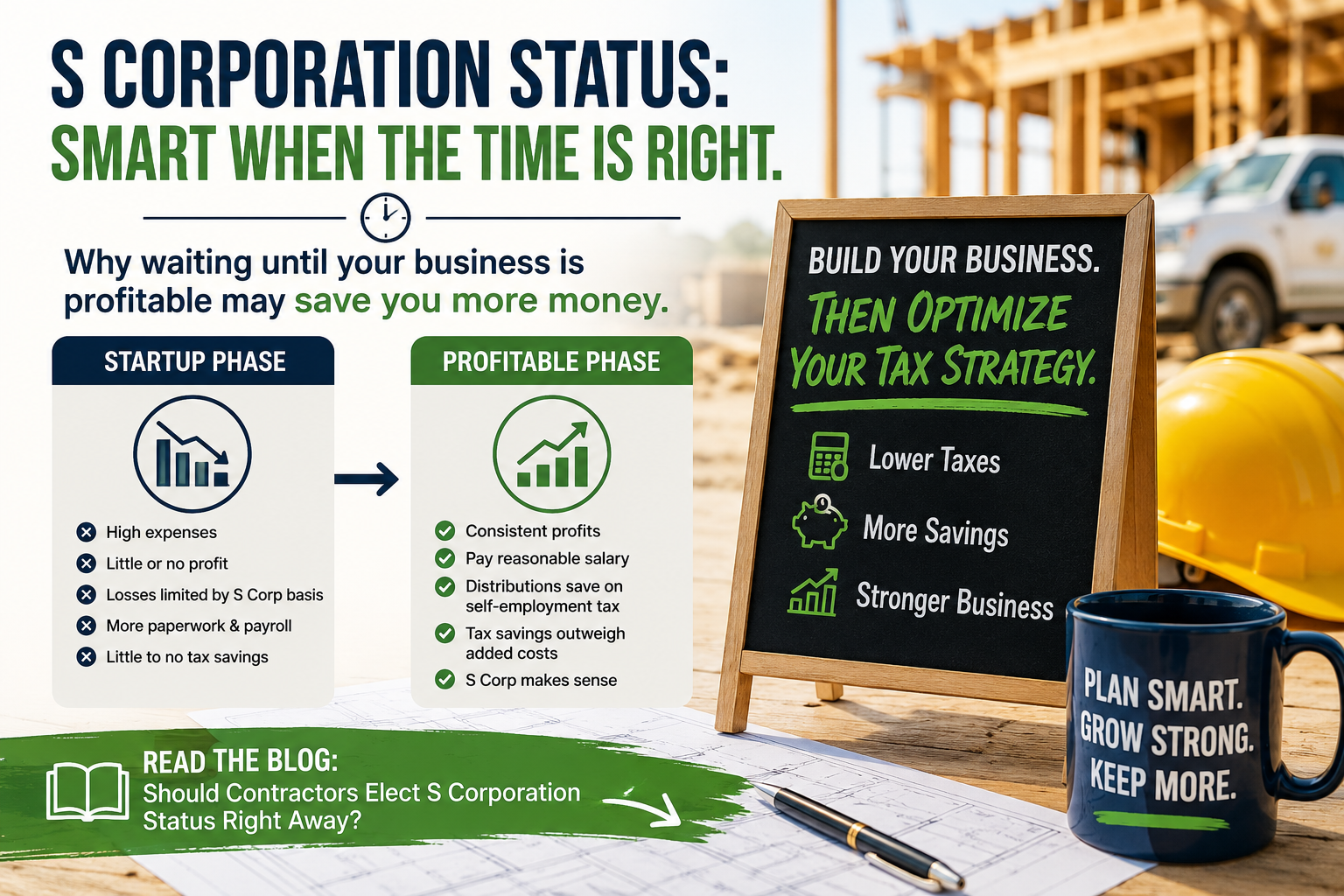
Why waiting until your business is profitable may actually save you more money.
One of the most common questions I hear from new contractors is: “Should I elect S Corporation status?”
Not necessarily. That answer surprises many people.
Social media, YouTube, and even well-meaning friends often tell new business owners that becoming an S Corporation is the key to saving thousands in taxes.
While an S Corporation can absolutely be an excellent tax strategy, it’s important to understand when it makes sense. For many contractors, electing S Corporation status too early can actually increase costs and limit valuable tax benefits.
Let’s look at why.
An S Corporation Is a Tax Strategy, Not a Startup Requirement
Many contractors begin as sole proprietors or form a single-member LLC. An LLC is a legal entity created under state law that provides liability protection. By default, a single-member LLC is generally taxed as a sole proprietorship unless another tax election is made.
An S Corporation is not a different type of business entity, it’s a tax election. Eligible businesses, including many LLCs, can elect to be taxed as an S Corporation by filing Form 2553 with the IRS. That election changes how the business is taxed, but it also brings additional responsibilities and compliance requirements.
The goal is to choose the structure that fits where your business is today, not where you hope it will be in five years.
Why So Many Contractors Eventually Choose an S Corporation
As a construction business grows, profits often increase significantly. That’s when an S Corporation can become a valuable tax planning tool. Here’s why.
A sole proprietor generally pays federal income tax, state income tax (where applicable) and self-employment tax on all net business profit. Self-employment tax covers Social Security and Medicare taxes.
Once profits become substantial, an S Corporation may reduce those employment taxes because the owner is generally paid in two ways: a reasonable salary, which is subject to payroll taxes, and shareholder distributions, which generally are not subject to self-employment tax.
The owner still pays income tax on the business income, but reducing the amount subject to Social Security and Medicare taxes can create meaningful savings.
Let’s Look At An Example
Suppose your construction company has gross revenue of $600,000, business expenses of $400,000, and net profit of $200,000.
As a sole proprietor, the entire $200,000 is generally subject to self-employment tax. If your business has elected S Corporation status, you might pay yourself a reasonable salary of $90,000 and take a distribution of $110,000.
The salary is subject to payroll taxes.
The distribution generally is not. (Note the distribution amount of $110,000, is not an expense to the business and therefore, is not a deduction for income tax purposes.)
That difference can result in significant payroll tax savings.
But Here’s What Many People Don’t Tell You…
The S Corporation only creates tax savings after your business becomes consistently profitable. For contractors, a current WIP schedule is the best way to know whether you are.
If your business isn’t generating enough profit to pay yourself a reasonable salary and still leave money available for distributions, the tax savings may be little or nothing.
Instead, you’ve simply created more paperwork.
When an S Corporation May Not Make Sense
Suppose your business has gross revenue of $180,000, business expenses of $150,000, and a net profit of $30,000.
If a reasonable salary for the work you perform is approximately $30,000, there may be little or no remaining profit available as distributions. In that situation you still have payroll processing, payroll tax deposits, quarterly payroll tax returns, annual W-2 preparation, corporate tax return, and additional accounting fees.
But very little tax savings.
That’s why profitability matters.
More Responsibilities Come With an S Corporation
Many business owners focus only on the potential tax savings. They forget about the additional administrative responsibilities. An S Corporation generally requires payroll processing, payroll tax filings, payroll tax deposits, W-2 preparation, separate corporate tax return (Form 1120-S), corporate recordkeeping, and shareholder basis tracking.
These aren’t necessarily reasons to avoid an S Corporation. They’re simply additional costs that should be justified by the tax savings.
Why Startup Losses Matter
This is one of the most overlooked reasons not to rush into an S Corporation election.
During the first few years, many contractors invest heavily in trucks, trailers, equipment, tools, advertising, office setup, software, and building a customer base. Those investments often create little profit, or even business losses.
As a sole proprietor, those losses flow directly to your individual tax return (assuming the other tax rules are met), where they may offset other income.
With an S Corporation, it’s different.
Understanding Shareholder Basis
One of the most important concepts in S Corporation taxation is shareholder basis.
Basis generally represents your investment in the corporation. It is increased and decreased over time based on contributions, income, losses, distributions, and certain loans made directly to the corporation.
Unlike a sole proprietorship, an S Corporation shareholder can generally deduct losses only to the extent of available stock basis and qualifying debt basis.
Even then, other rules, such as the at-risk rules and passive activity loss limitations, may further limit the deduction.
Let’s Look At An Example
Suppose you contribute $10,000 to your new S Corporation. Your initial stock basis is $10,000.
During your first year, the business loses $40,000. You have available basis of $10,000. Your current deductible loss is $10,000. The remaining $30,000 becomes a suspended loss until additional basis is created.
That suspended loss isn’t necessarily lost forever. It may become deductible in a future year once sufficient basis exists. However, you don’t receive the full tax benefit during the startup year.
Why Waiting Can Be a Smart Tax Decision
Many successful contractors spend their first few years simply building a profitable business. They’re investing in equipment, buying trucks, hiring employees, finding customers, learning how to estimate jobs accurately, and building cash flow.
That’s often not the ideal time to add payroll compliance and corporate tax filings if there is little or no tax benefit.
Once profits become steady and substantial, that’s usually the right time to sit down with your CPA and evaluate whether an S Corporation election makes financial sense.
Every Business Owner’s Situation Is Different
There is no magic income level that automatically means it’s time to elect S Corporation status.
The right decision depends on factors such as consistent profitability, expected future growth, reasonable compensation requirements, payroll costs, administrative costs, state tax considerations, and your overall tax situation.
That’s why the decision should always be based on your specific circumstances, not advice from social media or your friend who owns a business. Remember, every business owner’s situation is different. What makes sense for your friend, may not make sense for you.
The Bottom Line
An S Corporation can be one of the best tax-saving strategies available for a profitable business owner. But it isn’t automatically the best choice for a new business.
In many cases, remaining a sole proprietor during the startup phase provides greater flexibility while allowing you to fully benefit from startup losses. Once your business begins generating consistent profits, it’s time to evaluate whether an S Corporation election can reduce your overall tax burden.
The goal isn’t simply to pay less tax this year. The goal is to choose the structure that positions your business for long-term success.
Need Help Deciding?
Every business owner’s situation is unique, and choosing the wrong business structure can cost you money, or create unnecessary complexity.
At Melton Bookkeeping & Accounting Services, I help contractors understand not only how an S Corporation works, but when it makes sense to make the election. I also believe in a team approach, working alongside your CPA or tax preparer to ensure your bookkeeping supports the tax strategy that’s best for your business.
If you’re wondering whether it’s time to elect S Corporation status, I’d be happy to help you evaluate your options.
Schedule a consultation today, and let’s build a strategy that fits your business—not someone else’s.