
You’ve done your homework.
You’ve decided that offering Trump Account contributions makes sense for your business. The written program is in place. Payroll knows what to do. The accounting side is set up. You’re ready to go.
Well…almost.
There’s one more group we haven’t talked about yet: your employees.
And this part matters more than you might think.
Employees are already hearing about Trump Accounts on TV, social media, from financial institutions and probably from friends and family.
Some of what they’ve heard may be right. Some of it may not be. And some of it may have absolutely nothing to do with the benefit your company is actually offering. So don’t hand employees a three-page explanation full of tax-code language and expect them to figure it out. Tell them what they actually need to know.
What Should You Tell Employees About Trump Account Contributions?
Start with the simplest question: “What is the company giving me?“
If your company is contributing $1,000 per year, say that.
For example:
“Our company will contribute $1,000 each year to a qualifying Trump Account for eligible employees participating in our program.”
If you’re contributing $50 per pay period, say that. If employees have choices about which child’s account receives the money, explain those choices.
Employees don’t need a lesson on IRC Section 128 before they can understand their benefit.
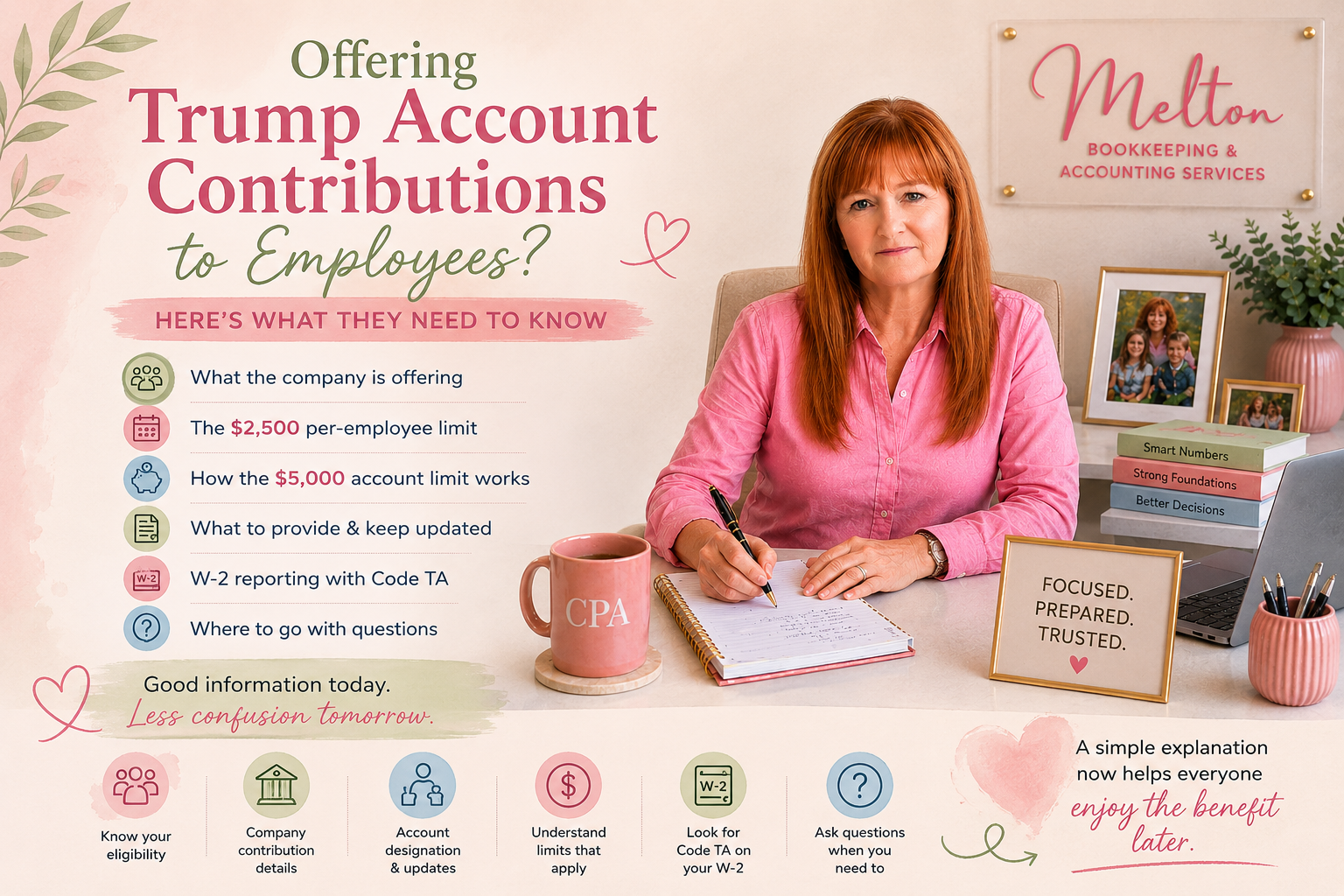
They need to know:
What am I getting?
Am I eligible?
Where does the money go?
What do I need to do?
That’s where I would start.
Is the $2,500 Trump Account Employer Limit Per Employee or Per Child?
This one is important because I think it’s very easy to misunderstand.
For 2026 and 2027, the Section 128 limit is generally $2,500 per employee per year. Not per child.
Suppose an employee has three children. That doesn’t mean the employer can provide $2,500 for Child #1, $2,500 for Child #2, and $2,500 for Child #3 for a total $7,500 tax-free benefit.
The limit is generally $2,500 for the employee.
Depending on the employer’s program, that amount may be divided among more than one qualifying Trump Account. But having more children doesn’t multiply the employee’s $2,500 limit.
What If the Employee Has Two Jobs?
Here’s something employees should know.
You know what your company contributed. You probably don’t know what another employer contributed. Suppose an employee works for two unrelated companies and both companies offer Trump Account contributions. The combined contributions could potentially create a tax issue for the employee if they exceed the applicable federal limit. That’s not something your payroll department can necessarily catch.
So I’d tell employees: If you receive Trump Account contributions from more than one employer, let your tax preparer know. It’s that simple.
You don’t need to calculate their personal tax consequences for them.
What Information Will Employees Need to Provide?
Employees will probably need to give the company information about the Trump Account and the person receiving the benefit.
Depending on your program, that may include things such as:
- Beneficiary’s name;
- Relationship to the employee;
- Date of birth;
- Information about whether the person qualifies as a dependent;
- Trump Account information;
- Information needed to send the contribution to the correct account.
Make it clear that employees are responsible for providing accurate information and give them a way to update it. People get divorced. Custody arrangements change. Dependents change. Financial institutions change. Employees leave. Accounts change.
You don’t want somebody saying: “Oh, I meant to tell you about that six months ago.”
Tell employees from the beginning what kinds of changes they need to report and who they should tell.
What If an Employee Isn’t Sure Their Child Qualifies?
This is where I think employers need to know when to stop.
Let’s say an employee asks HR: “My ex-wife claims our daughter this year, but I claim her next year. Does she qualify as my dependent for this program?”
That’s probably not a question you want your office manager answering from Google. Dependency rules can get complicated, especially with divorced or separated parents and different custody arrangements. There’s nothing wrong with saying: “You’ll need to check with your tax advisor about whether this person qualifies as your dependent under the tax rules.”
Your job is to administer your company’s benefit. You don’t have to become everyone’s personal tax preparer.
Where Does the Employer’s Trump Account Contribution Go?
Employees also need to understand something very basic: This isn’t extra money in their paycheck.
If the company says: “We’re contributing $1,000 to your child’s Trump Account,” that doesn’t mean the employee gets an extra $1,000 deposited into their checking account. The employer contribution goes to the qualifying Trump Account designated under the company’s program.
Give employees simple instructions explaining:
- How to designate the account;
- What information they need to provide;
- When contributions will be made;
- What happens if they don’t provide the required information;
- How they can change account information;
- Who to contact with questions;
The easier you make the process, the fewer problems everyone will have later.
Can Employees Contribute Through Payroll Too?
Depending on how the employer’s benefits are structured, some employers may also allow employees to contribute through payroll under additional rules.
This is one area where I would give employees a separate explanation rather than burying it inside the employer-contribution information.
If your company offers this option, employees need to understand:
How much will come out of my paycheck?
Which Trump Account can receive it?
When does my election start?
How do I change it?
How do I stop it?
How does it affect my paycheck?
Don’t add another box to the payroll form and assume everyone understands what they’re signing.
What Is Code TA on Form W-2?
Here’s a question payroll departments may start hearing in January: “What is Code TA on my W-2?”
Qualifying employer Trump Account contributions under Section 128 are reported in: Form W-2, Box 12, Code TA. Tell employees that when you introduce the benefit. A simple explanation might be: “At year-end, the company’s qualifying Trump Account contributions will be reported in Box 12 of your W-2 using Code TA.”
That’s probably all most employees need to know. And you’ve just eliminated at least a few January emails to payroll.
You’re welcome. 😊
Is the Government’s $1,000 Trump Account Contribution the Same as the Employer Contribution?
The answer is no. This is one distinction I would make very clear. There are two completely different things being talked about.
The government’s $1,000 contribution
Certain qualifying children born from January 1, 2025 through December 31, 2028 may qualify for a one-time $1,000 contribution from the federal government. Notice again this is a one time contribution. It isn’t $1,000 every year.
The employer contribution
Your company may separately contribute to qualifying Trump Accounts through its employer program. That money comes from the employer, not the federal government. If your company happens to contribute $1,000 too, employees could very easily confuse the two. So spell it out.
Government contribution = one thing.
Employer contribution = something different.
What About the Child’s $5,000 Trump Account Limit?
Employees should also know that the employer contribution doesn’t exist in its own little bubble.
For 2026 and 2027, the general Trump Account contribution limit is generally $5,000 per child for contributions subject to that limit. Employer Section 128 contributions generally count toward that $5,000.
So, for example:
Employer contributes: $1,000
Parents contribute: $2,000
Grandparents contribute: $2,000 Total = $5,000
That child’s general annual limit has been reached.
The qualifying government’s one-time $1,000 contribution generally doesn’t count toward that $5,000 limit.
This is something employees should understand if parents, grandparents and an employer are all putting money into the same child’s account.
Give Employees Something in Writing
Please don’t explain all of this in a staff meeting and assume everyone will remember it. Give employees something they can keep. It doesn’t need to be 15 pages long. In fact, I’d argue that it shouldn’t be.
I’d create a simple employee handout answering the following questions.
- Am I eligible?
- How much does the company contribute?
- Is that amount per employee or per child?
- When will the company make contributions?
- Where does the money go?
- What information do I need to provide?
- How do I change my account information?
- Does the company allow employee contributions through payroll?
- What happens if I have another employer offering this benefit?
- What is Code TA on my W-2?
- Who do I contact with questions?
Then give employees the appropriate program documents along with it. The goal isn’t to make your employees experts on Trump Accounts. The goal is to make sure they understand their benefit.
Don’t Promise Employees “$2,500 Tax-Free”
This is another wording issue I’d be careful about.
It’s tempting to advertise the benefit as: “We’ll give you up to $2,500 completely tax-free!” I would avoid that.
There are limits and requirements involved, and an employee’s individual circumstances can matter. For example, the employee could receive Section 128 contributions from another employer.
Instead, I’d say something like: “Qualifying employer contributions may receive favorable federal tax treatment under Section 128, subject to applicable limits and requirements.”
Okay, yes. That’s slightly more boring. But sometimes boring is good—especially when we’re talking about payroll and taxes.
Frequently Asked Questions About Trump Account Employee Benefits
Is the $2,500 employer limit per employee or per child?
Per employee. For 2026 and 2027, the Section 128 exclusion is generally limited to $2,500 per employee per year. Having multiple children doesn’t create multiple $2,500 limits.
Does the employer contribution go into my paycheck?
No. The employer contribution is generally sent to the qualifying Trump Account designated under the employer’s program rather than paid to the employee as additional take-home pay.
Does an employer Trump Account contribution count toward the child’s $5,000 annual limit?
Yes. Employer Section 128 contributions generally count toward the child’s $5,000 annual limit for contributions subject to that limit.
Is the government’s $1,000 contribution the same as my employer’s contribution?
No. The government’s contribution is a separate one-time $1,000 contribution for certain qualifying children born from 2025 through 2028. Your employer’s contribution comes from your employer under its Trump Account Contribution Program.
What is Code TA on my W-2?
Qualifying employer Section 128 Trump Account contributions are reported in Box 12 of Form W-2 using Code TA.
What if two employers contribute for me?
If you receive Section 128 Trump Account contributions from more than one employer, make sure your tax preparer knows about both. The employers may not know what each other contributed.
Who should I ask if I’m not sure whether my child qualifies?
Ask your tax advisor if you’re uncertain whether someone meets the applicable dependency or other tax requirements. Your employer can explain its program, but your employer shouldn’t be expected to provide individualized tax advice.
Are these rules final?
No. The Treasury Department and IRS issued proposed regulations in August 2026 under REG-101355-26. The rules may change before the regulations are finalized.
The Bottom Line
A good employee benefit isn’t very helpful if nobody understands it.
If your business decides to offer Trump Account contributions, tell your employees—in plain English. Tell them
What you’re giving them.
Who qualifies.
Where the money goes.
What they need to do.
What they need to tell you.
And who to ask when they have questions.
The rules behind the scenes may be complicated. Your explanation to employees doesn’t have to be. Get the program right. Get payroll right.
Then make sure your employees actually understand the benefit you’re giving them.
Continue the Trump Account Series
Part 1: Trump Accounts Explained: Who Qualifies, the $1,000 Contribution, and How They Work
[LINK TO PART 1]
Part 2: Before Your Business Starts Contributing to Employees’ Trump Accounts, Read This
[LINK TO PART 2]
Part 3: Your Client Wants to Offer Trump Account Contributions — Now What Happens in Payroll?
[LINK TO PART 3]
Part 4: Offering Trump Account Contributions to Employees? Here’s What They Need to Know
You are here.
This article discusses proposed Treasury regulations issued in August 2026. The rules may change before they are finalized. This article is intended for general educational purposes and isn’t individualized tax, legal, investment, payroll or employee-benefits advice.