
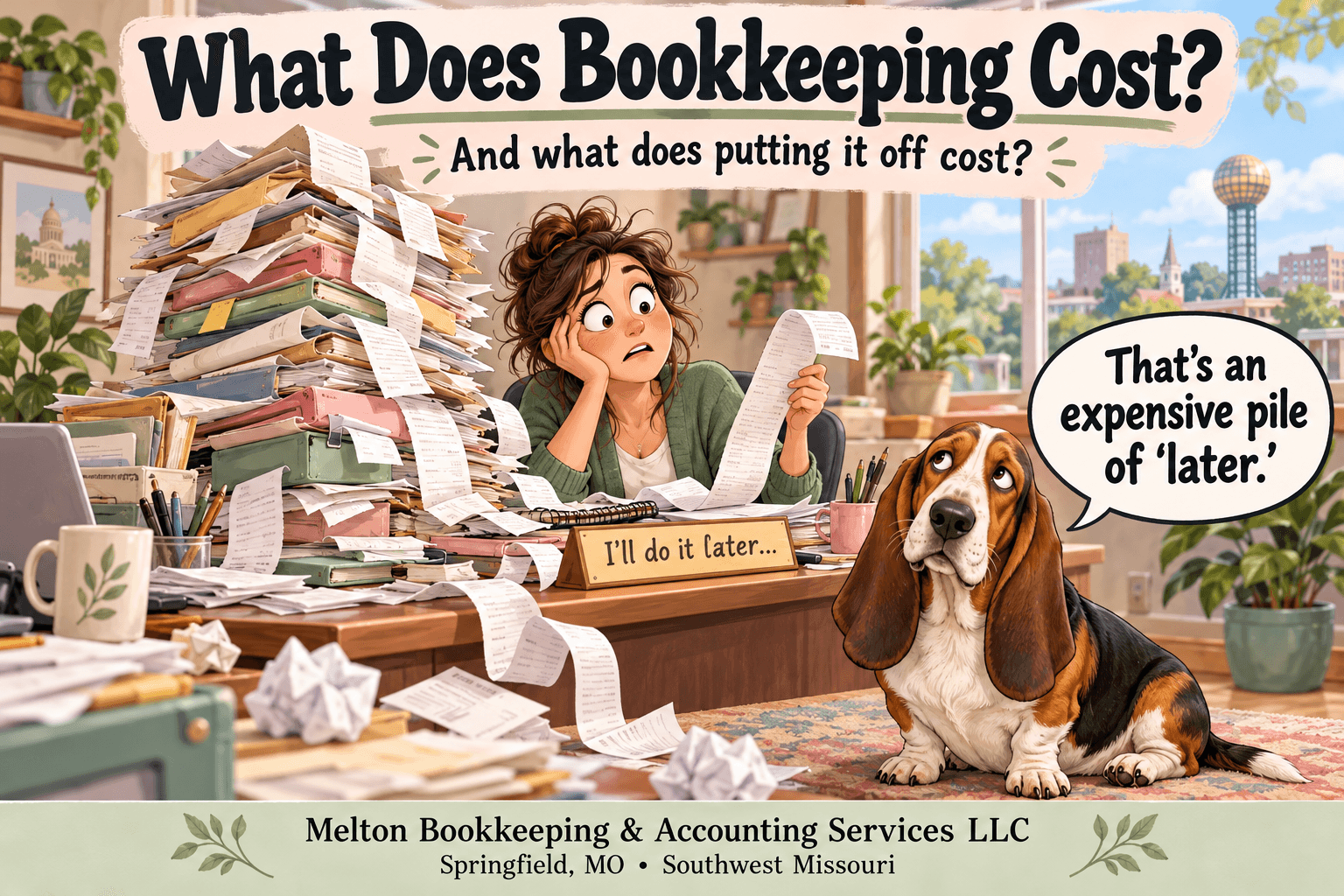
If you own a small business in Springfield, Missouri, or the surrounding area, you may be wondering whether monthly bookkeeping fits your budget. What are current bookkeeping costs in Springfield, Missouri? While I can’t speak for every firm in Southwest Missouri, I can give you a transparent look at how we price our monthly bookkeeping services here at Melton Bookkeeping & Accounting Services.
Our monthly services start at $250 for basic reconciliation support, while broader monthly bookkeeping packages start at $550. For businesses requiring extensive accounting or specialized construction reporting, starting prices are higher.
Ultimately, your price depends on the specific work your business needs. A small service provider with one checking account and a handful of monthly transactions needs a completely different level of support than a construction contractor managing multiple jobs, customer billings, and retainage.
But there is another part of this financial conversation that we really need to address. What happens when the books are left until later? The monthly fee is easy to see on an invoice, but the true cost of falling behind can take much longer to show up.
What Does Monthly Bookkeeping Cost?
To give you an idea of bookkeeping costs in Springfield, Missouri, and what to expect, here are my current starting prices for businesses in Springfield, Marshfield, Nixa, Ozark, Rogersville, and our surrounding Southwest Missouri communities.
Our Foundation Tier starts at $250 per month. This provides basic monthly reconciliation support for a low-volume business that maintains its books in QuickBooks Online. This covers one checking account with standard bank feeds.
Our Growth Tier starts at $550 per month. This is designed for established businesses needing broader monthly bookkeeping, full financial reporting, and additional advisory services tailored to your specific operations.
Our Elite Tier starts at $1,250 per month. This tier provides more extensive bookkeeping or a deep accounting review for higher-volume businesses or more complex operations.
Our Construction & Advanced Tier starts at $2,000 per month. This specialized support is built for project-based businesses that require detailed job costing, work-in-progress (WIP) reporting, and ongoing analysis of billings versus actual costs.
Please keep in mind that these are starting prices for my firm specifically. Your final fee will depend on your average transaction volume, the number of accounts you have, your specific reporting needs, and the services you request. If your books are currently behind, cleanup and historical catch-up work are priced separately.
What Makes the Price Go Up or Down?
The number of transactions matters, but so does what those transactions actually involve. For example, recording a straightforward customer payment takes a few seconds. Sorting out a lump-sum bank deposit that includes several different invoices, merchant processing fees, and a partial customer payment is a completely different story.
When we look at bookkeeping costs in Springfield, Missouri, we look at how many bank accounts, credit cards, and loan accounts need attention, and whether customer invoices and vendor bills require ongoing tracking. We also consider whether you need help recording payroll entries and payroll tax reporting. While I don’t process payroll directly, we often include payroll recording and reconciliation in our monthly packages when agreed upon.
Other factors include whether you need advanced reporting by job, project, or rental property, how much regular review and explanation you want each month, and whether your existing historical books are current and accurate. When you compare quotes from various professionals, always ask exactly what the fee covers. A basic reconciliation package and a full-service monthly bookkeeping package serve two entirely different business needs.
I often like to say that I prepare clean, organized and tax-ready books, but that is only possible if I am doing full bookkeeping or bookkeeping review services. Books are probably not going to be “tax-ready” if the bookkeeper is only doing your bank and credit card reconciliations.
What Does It Cost to Skip Monthly Bookkeeping?
Accurate bookkeeping requires more than entering transactions or accepting suggestions in QuickBooks. It takes accounting knowledge to recognize when something is wrong, understand how it affects your financial reports, and correct it properly. Errors can go unnoticed for months while the reports still appear reasonable.
When bookkeeping is postponed or handled without that knowledge, the cost can extend well beyond the eventual cleanup bill.
A larger, more expensive cleanup project.
A question about last month’s deposit is usually easy to answer while it is still fresh in your mind. Six months later, finding that same answer might require digging through old bank statements, invoices, buried emails, and having a long conversation to jog your memory. If errors repeat month after month, there is much more to untangle. Catching up on missing entries and correcting inaccurate entries are two very different kinds of work, and both can add up to a significant bill.
Time taken away from your business.
Bookkeeping done after dinner or on the weekends still uses your valuable time. The practical question is whether those hours could be better used serving your customers, managing your team, or simply enjoying an evening off with your family.
Consider a salon owner who charges $200 for an appointment that takes about two hours. If she spends eight hours doing her own books, and hates every minute of it, that is enough time for four appointments. If she turns down those appointments to work on bookkeeping, she gives up $800 in potential revenue.
Even when she does the books after hours, there is still a cost. It is an evening with her family, a weekend off, or time to rest before another busy week. Doing your own bookkeeping may avoid a monthly fee, but your time has value, too.
A misleading picture of your true profit.
QuickBooks can produce a beautifully polished report even when the underlying entries are completely wrong. I often tell my clients, and I will paraphrase for this blog, “What goes in, is what comes out.”
Intuit identifies duplicate transactions in QuickBooks Online as a problem that can occur when a downloaded deposit is added as new income instead of matched to an existing payment.
For instance, an invoice already recorded as income can easily be counted a second time if its bank deposit is added as new income instead of being matched to the customer payment. This duplicate income recorded in error means you could end up paying taxes on money your business never actually made. On the flip side, missing expenses can make your profit look much better than it really is. Both scenarios can lead to dangerous blind spots when you make decisions about hiring, spending, pricing, or the information you hand over to your tax preparer.
Cash flow problems that surface too late.
A bank balance tells you what is sitting in your account right this second. It does not tell you which customer invoices are critically overdue or what big bills are coming due next week. Current books help you see those obligations coming and allow you to follow up on unpaid invoices before it’s too late. Waiting until year-end often means discovering a severe collection or cash flow problem long after it started.
Far more work and stress at tax time.
Having worked in public accounting for more than 23 years, I can tell you firsthand that reliable records make a difference at tax time. But business owners should understand that tax preparation and a thorough bookkeeping review are separate services.
The scope of a tax engagement may involve preparing a return from the information you provide. It does not necessarily include reconciling accounts, investigating unusual balances, or checking the transactions behind your financial reports.
Treasury regulations generally allow tax preparers to rely in good faith on client-provided information without independently verifying every record. Preparers must, however, make reasonable inquiries when information appears incorrect or incomplete.
Even when year-end journal entries are made, those adjustments may address only the issues identified during tax preparation. An entry can change a balance without resolving the underlying transactions or correcting the process that caused the problem. For example, moving an unexplained amount to owner distributions or another equity account does not, by itself, establish what that amount actually represents.
That means bookkeeping problems can carry into the next year, even after your tax return has been filed.
Monthly bookkeeping gives those questions regular attention, while the details are still fresh and supporting documents are easier to find. It also helps your tax preparer identify and support allowable deductions using more reliable information.
Ask your tax preparer what bookkeeping review is included in their fee, and make sure someone is responsible for investigating unresolved balances throughout the year. Your business should also retain receipts and supporting documents, because those documents support the information recorded in your books and reported on your tax return.
Jobs that look profitable until the costs catch up.
For our local contractors, total company profit rarely tells the whole story. One highly profitable job might be quietly carrying another failing project. Unrecorded costs, outdated estimates, or incomplete change-order information can completely distort your financial picture. Regular monthly job costing and work-in-progress reporting help us identify these questions while the project is still underway and fixable. Just remember that these reports depend entirely on timely information; a bookkeeper cannot account for a material cost or a contract change order that hasn’t been provided yet.
What Should You Expect for Your Monthly Fee?
Before you hire any financial professional, I always recommend asking a few clarifying questions so everyone is on the same page. You want to know more than the bookkeeping costs in Springfield, MIssouri. Make sure you know exactly which accounts they will reconcile and review, what specific reports you will receive, and how often you will get them. Find out who is responsible for following up on missing information, whether historical cleanup is included or quoted separately, and what specific tasks will still fall on your shoulders. Finally, ask how they will coordinate with your tax preparer at year-end. You should leave the conversation with a clear understanding of both the fee and the responsibilities on each side.
A Package That Fits Your Business
I am Paula Melton, a CPA with more than two decades of public accounting experience. I work directly with established small businesses in Springfield, Marshfield, Nixa, Ozark, Rogersville, and throughout Southwest Missouri.
My approach to pricing bookkeeping costs in Springfield, Missouri is simple: I ask questions, I listen, and I look closely at what your numbers are trying to tell us. I want you to have clear, accurate financial records you can use to run your business throughout the year, along with a complete understanding of the professional support you are paying for.
If you have been putting off your bookkeeping and are ready to hand off the stress, call my office today at (417) 630-0057. We can discuss exactly where your books stand right now and figure out what level of help makes the most sense for your business.