
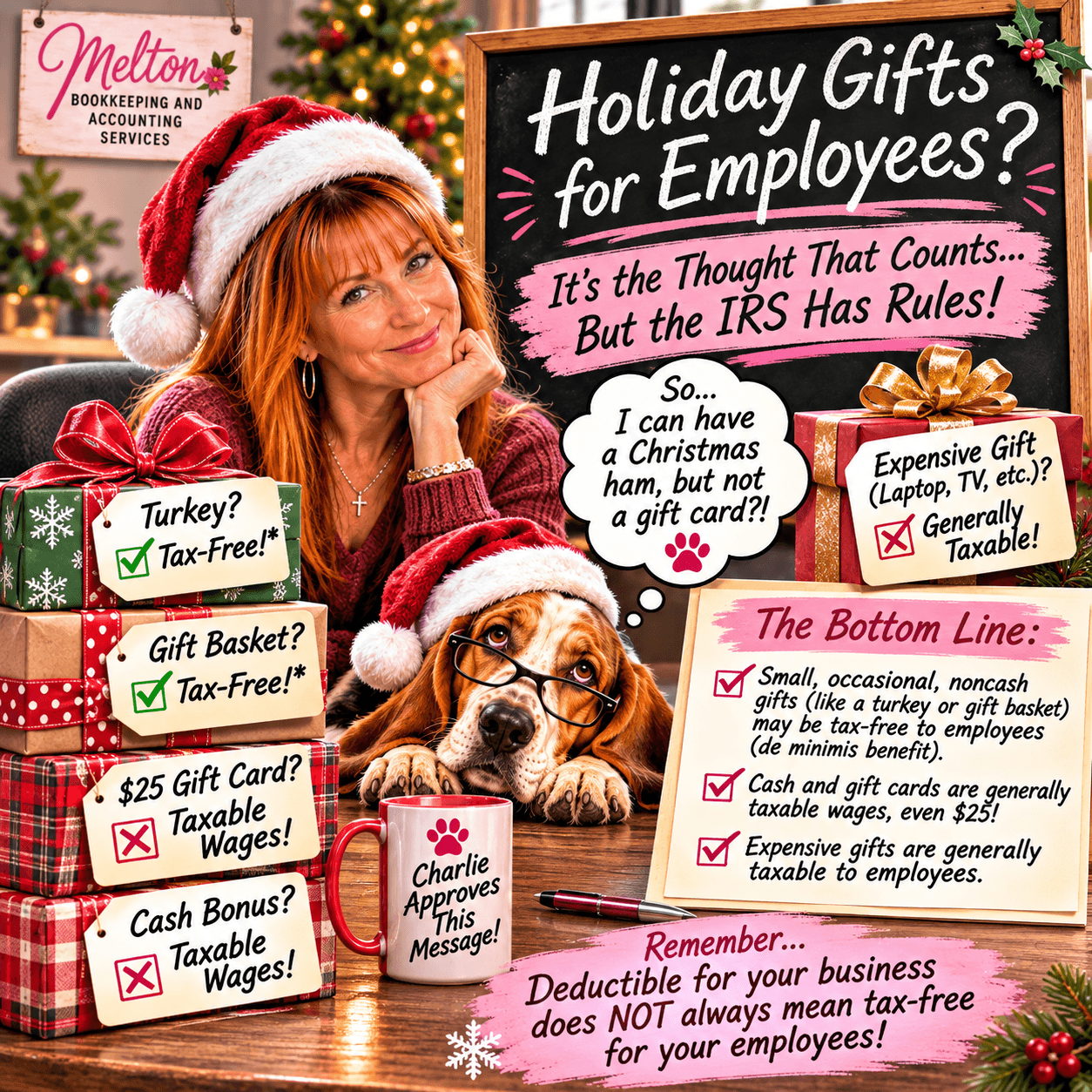
Why employee Christmas gifts matter, and what every small business owner should understand about the IRS rules.
Every Christmas season, business owners start thinking about ways to show their employees how much they appreciate them. And I want to say something before we get into all the IRS rules.
PLEASE, if you’re in a position to do something special for your employees this Christmas, DO IT!
Think about what those employees have done for your business over the past year. They’ve shown up for work when they probably would have preferred to stay home. They’ve dealt with difficult customers, unexpected problems, tight deadlines, and days when absolutely NOTHING seemed to go right.
They’ve helped you serve your customers, complete your projects, and keep your business operating.
And let’s face it. Sometimes employees hear a whole lot more about what they’ve done WRONG than what they’ve done RIGHT. The mistake gets pointed out. The unhappy customer gets discussed. The job that went over budget gets everyone’s attention.
But what about the hundreds of things they did right? What about the employee who stayed late to finish a job? The one who stepped in when someone called in sick? The one who took care of a customer without being asked? Those employees have helped keep YOUR business going all year long.
And sometimes a Christmas bonus, a thoughtful gift, or even a sincere handwritten note can mean more to an employee than you realize. It’s not always about the dollar amount. It’s about someone recognizing their hard work and saying, “I see what you do. I appreciate you. And I’m glad you’re part of this business.”
That’s powerful.
I’ve always believed that employees who feel appreciated are more likely to take pride in their work. And when you have good employees, you want to keep them!
So this article is NOT intended to discourage you from giving Christmas gifts or bonuses. Quite the opposite! I want you to show your employees how much you appreciate them. I just want you to understand the tax rules so you can do it correctly.
Because here’s something that surprises business owners every single year. You can give an employee a modest Christmas turkey, and it may be tax-free. But give that same employee a $25 gift card to purchase the turkey? That gift card is generally taxable wages! Yes, really.
And that’s where our discussion about employee Christmas gifts and the IRS begins.
The $25 Gift Card That Causes All the Confusion
Let’s say you own a construction company with 10 employees. You want to thank everyone for their hard work, so you purchase ten $25 Walmart gift cards. You spend $250, hand out the cards, and everyone is happy.
You record the $250 in QuickBooks as “Employee Christmas Gifts.” End of story, right?
Not quite!
Those $25 gift cards are generally considered taxable compensation to your employees. That means the value should be included in their wages, with applicable payroll tax withholding and reporting.
“But Paula, it’s only $25!” I know!
“But it’s Christmas!” I know that, too!
“But I’m giving them a gift, not paying them extra wages!” I understand. Unfortunately, calling something a gift doesn’t automatically make it tax-free.
For tax purposes, cash and cash-equivalent gift cards provided by an employer are generally treated as compensation, regardless of how small the amount is.
And that’s where many business owners get surprised.
Why Is a Christmas Turkey Different From a Gift Card?
The IRS has a provision for something called a de minimis fringe benefit.
That’s a fancy tax term for certain small, occasional benefits that are so minimal in value and frequency that accounting for them would be unreasonable or administratively impractical.
Examples may include the following:
- A modest Christmas turkey or ham
- A small holiday gift basket
- An occasional inexpensive birthday gift
- Flowers or fruit given for a special occasion
- Other occasional, low-value noncash gifts
When these gifts meet the IRS requirements, their value generally doesn’t have to be included in the employee’s taxable wages.
Now, here’s where it gets interesting. Give your employee a modest Christmas turkey, and it may be tax-free. Give your employee a $25 grocery store gift card to purchase that turkey, and the gift card is generally taxable.
Same intention. Similar value. Different tax treatment! Why?
Because cash and cash equivalents have a readily determinable value. They generally don’t qualify for the de minimis exclusion.
There are narrow exceptions involving certificates redeemable only for specific low-value items, but an ordinary grocery store, restaurant, Visa, or Amazon gift card generally doesn’t qualify.
Is There a Dollar Limit for Tax-Free Employee Gifts?
Here’s another misunderstanding I encounter. Some business owners believe that employee gifts are tax-free as long as they cost less than $25.
That is NOT a general IRS rule for employee gifts!
The familiar $25 business gift deduction limitation generally concerns gifts to business contacts, such as customers, not ordinary employee compensation.
For employee gifts, the de minimis rules focus on the value, frequency, and circumstances of the benefit. There is no universal IRS rule saying that every noncash employee gift under $25 is tax-free, or that every gift over $25 is taxable.
A modest holiday gift basket given once a year may qualify. An expensive television probably won’t. And a $10 cash gift is generally taxable compensation, even though the amount is small. The type of gift matters just as much as the amount.
What About Expensive Christmas Gifts?
Let’s say you have an employee who’s done an outstanding job this year. You decide to surprise that employee with a $900 laptop for personal use. That’s a generous gesture! But an expensive personal gift generally doesn’t qualify as a de minimis fringe benefit.
Its fair market value would ordinarily be taxable compensation to the employee, unless another specific tax exclusion applies. The same concern applies to expensive jewelry, electronics, and other high-value personal gifts.
There are special rules for certain qualifying employee achievement awards, but those rules are separate from ordinary Christmas gifts.
And no, simply calling an expensive Christmas present an “employee appreciation award” doesn’t automatically make it tax-free.
Deductible for the Business Does NOT Mean Tax-Free to the Employee!
If there’s one tax rule I want you to remember from this article, it’s this: An expense can be deductible to your business and still be taxable income to your employee.
Let’s look at three examples.
| Employee gift | Business treatment | Employee treatment |
| Modest Christmas turkey | Generally deductible | Generally tax-free |
| $25 Visa gift card | Generally deductible as compensation | Taxable wages |
| $500 cash Christmas bonus | Generally deductible as compensation | Taxable wages |
The business may receive a deduction in each situation, but that doesn’t mean the employee receives the benefit tax-free. These are two different tax questions. And both matter!
Christmas Bonuses Need to Go Through Payroll
Now let’s talk about cash Christmas bonuses.
Suppose you have five employees, and you decide to give each of them a $500 Christmas bonus. That’s $2,500 in bonuses. You might be tempted to write each employee a $500 check directly from the business checking account.
But cash bonuses are generally supplemental wages and are subject to applicable federal and state income tax withholding, Social Security, and Medicare taxes. They also generally need to be included in the employees’ Forms W-2.
The proper way to handle those bonuses is through payroll.
And here’s another thing to consider. If you tell an employee they’re receiving a $500 bonus, that doesn’t necessarily mean they’ll take home $500 after taxes. If your intention is for the employee to receive exactly $500 in their pocket, you may need to gross up the bonus. That means calculating a larger gross bonus so the employee receives the intended net amount after applicable withholding. And yes, that costs the business more money.
It’s something worth discussing with your payroll provider BEFORE you promise employees a specific take-home amount.
What Happens When Gift Cards Are Purchased but Never Added to Payroll?
This is where I see a potential problem for business owners. Let’s go back to those ten $25 Walmart gift cards. You purchased them using your business credit card and recorded the $250 in QuickBooks. Your books show an expense. Everything reconciles. But nobody told the payroll provider about the gift cards.
Your bookkeeping may be accurate as far as the money spent, but your payroll reporting may still be wrong!
Those gift cards generally need to be included in employee taxable wages. If they’re overlooked, the business could have incorrect payroll tax reporting, withholding, and Forms W-2. And depending on when the error is discovered, correcting it could mean amended payroll returns, corrected W-2s, and potentially additional taxes or penalties.
That’s a lot of extra work over a $25 Christmas gift card!
This is one reason I encourage business owners to communicate with their bookkeeper, accountant, and payroll provider. They all need to know what’s happening.
Don’t Confuse Employee Gifts With Customer Gifts
There’s another rule that gets mixed into this discussion.
You’ve probably heard that businesses can deduct only $25 per person for business gifts. That’s a real tax rule, but it generally applies to gifts given to business contacts, such as customers and clients, subject to various exceptions. It isn’t a blanket limitation on what you can deduct for employees.
For example, a $500 taxable employee bonus isn’t automatically limited to a $25 business deduction. It is generally treated as compensation, subject to the usual requirements for deductible business compensation. So please don’t confuse the rules for customer gifts with the rules for employee gifts. They’re not the same!
What About the Company Christmas Party?
While we’re talking about holiday expenses, let’s address another common question. Can your business deduct the company Christmas party? In many cases, yes!
Qualifying holiday parties or recreational events held primarily for the benefit of employees other than certain owners and highly compensated employees can generally be 100% deductible.
And the employees aren’t taxed on the value of an occasional qualifying holiday party.
That’s different from the usual rules limiting many business meal deductions.
Of course, the circumstances matter. An event primarily benefiting owners or a select group of executives may not receive the same treatment. But a traditional company Christmas party for employees can be a great way to show appreciation while potentially receiving favorable tax treatment.
How Should You Record Employee Christmas Gifts in QuickBooks?
This is where good bookkeeping and good communication come together.
I recommend keeping enough detail to distinguish among:
- Small, occasional noncash employee gifts that qualify as de minimis benefits
- Taxable gift cards and cash bonuses
- Other taxable employee gifts
- Qualifying employee holiday parties
- Customer and client gifts
Why? Because these expenses may have different tax and payroll reporting requirements.
If your business purchases taxable employee gift cards, the payroll provider needs the information necessary to include those amounts in wages. The bookkeeping should also be coordinated with payroll so the expense isn’t deducted twice when the payroll entries are recorded. And please keep your receipts and a record of who received the gifts!
A transaction labeled “Christmas Gifts” in QuickBooks doesn’t tell your tax preparer whether the money was spent on employees, customers, gift cards, or a holiday party. Those details matter.
A Christmas Gift Is About More Than a Tax Deduction
Before we wrap this up, I want to return to something I said at the beginning. Your employees are people. Not just numbers on your payroll report. They have families, bills, worries, responsibilities, and lives outside your business. And during the holidays, a little extra money can make a real difference.
A Christmas bonus might help an employee buy presents for their children, pay an unexpected bill, or simply enjoy the holidays with a little less financial stress. A thoughtful gift might tell an employee that you actually pay attention to who they are and what matters to them.
And sometimes, hearing “Thank you for everything you’ve done this year” from the person who signs their paycheck means more than you might imagine.
Now, I understand that not every small business can afford large Christmas bonuses. Some years are better than others. I’ve worked with enough small business owners to know that cash flow can be tight, especially at year-end. But appreciation doesn’t always require a big budget. A small gift, a handwritten card, a company Christmas lunch, or simply taking time to recognize someone’s contributions can go a long way.
And if your business has had a particularly successful year, consider the people who helped make that success possible.
Your employees helped you earn that money. Sharing a little of your success with them is a wonderful way to say thank you.
Just remember that when you choose to give cash, gift cards, or other taxable gifts, you’ll need to handle the payroll reporting correctly. Don’t let the tax rules scare you away from showing appreciation. Plan for them!
If you want your employee to receive a certain amount after taxes, talk to your payroll provider about grossing up the bonus. If you want to give a modest noncash gift, understand the de minimis fringe benefit rules.
And if you want to throw a Christmas party, find out whether the expense qualifies for the 100% employee recreational event deduction.
There are ways to show appreciation while still following the rules.
Charlie, the basset hound in all of my social media, and my personal office “assistant” has a few questions about his Christmas bonus.
Of course, Charlie has been listening to this entire discussion. He was very interested when I mentioned that a Christmas ham might qualify as a tax-free gift. He was considerably less interested in hearing about taxable gift cards.
He’s now requesting a Christmas ham, a new orthopedic dog bed, and a substantial increase in his annual treat allowance. He also wants to know whether he can receive a performance bonus for keeping me company during tax season.
I’m still trying to determine exactly what performance he’s referring to. He’s currently asleep under my desk. Apparently, supervising the accountant is exhausting work! 🐾😂
My Advice to Business Owners This Christmas
Please don’t stop showing your employees how much you appreciate them! Good employees deserve recognition, and a thoughtful Christmas gift can mean a lot. Just understand the tax consequences before you start handing out cash, gift cards, or expensive presents.
Here’s what I’d encourage you to do:
- Decide what type of gifts or bonuses you want to give.
- Determine whether the gifts are taxable compensation.
- Coordinate taxable gifts and bonuses with your payroll provider.
- Keep records of purchases and recipients.
- Make sure your bookkeeping and payroll reporting agree.
And remember, the IRS doesn’t determine whether your gift is thoughtful. It determines how that gift is taxed!
A little planning now can help you avoid an unpleasant surprise when it’s time to prepare payroll tax reports and Forms W-2.
One Last Thought
Business owners spend a lot of time thinking about customers. How do we attract them? How do we keep them happy? How do we get them to come back? Those are important questions.
But I’d encourage you to ask yourself one more: “When was the last time I made sure my employees knew how much I appreciate them?”
Because while you’re busy taking care of your customers, your employees are helping take care of your business. And that’s something worth celebrating.
The only surprise you want to give your employees at Christmas is what’s inside the wrapping paper, not what’s on their W-2! Merry Christmas!
Need Help Making Sense of Your Business Expenses?
At Melton Bookkeeping & Accounting Services LLC, I help small business owners understand their financial records, properly classify transactions, and prepare for tax season.
With more than 20 years of experience in public accounting and tax preparation, I’ve seen how seemingly small bookkeeping decisions can create bigger problems when tax season arrives.
My goal is to help business owners understand not just where to record an expense, but why the details matter.
If you’re a business owner in Marshfield, Springfield, or Southwest Missouri and have questions about bookkeeping, tax preparation, or year-end planning, I’d be happy to visit with you.
Melton Bookkeeping & Accounting Services LLC
🌐 https://meltonaccountingservices.com/
This article provides general federal tax information and is not a substitute for advice tailored to your particular business. State tax rules and specific circumstances may affect the treatment of employee gifts and benefits.