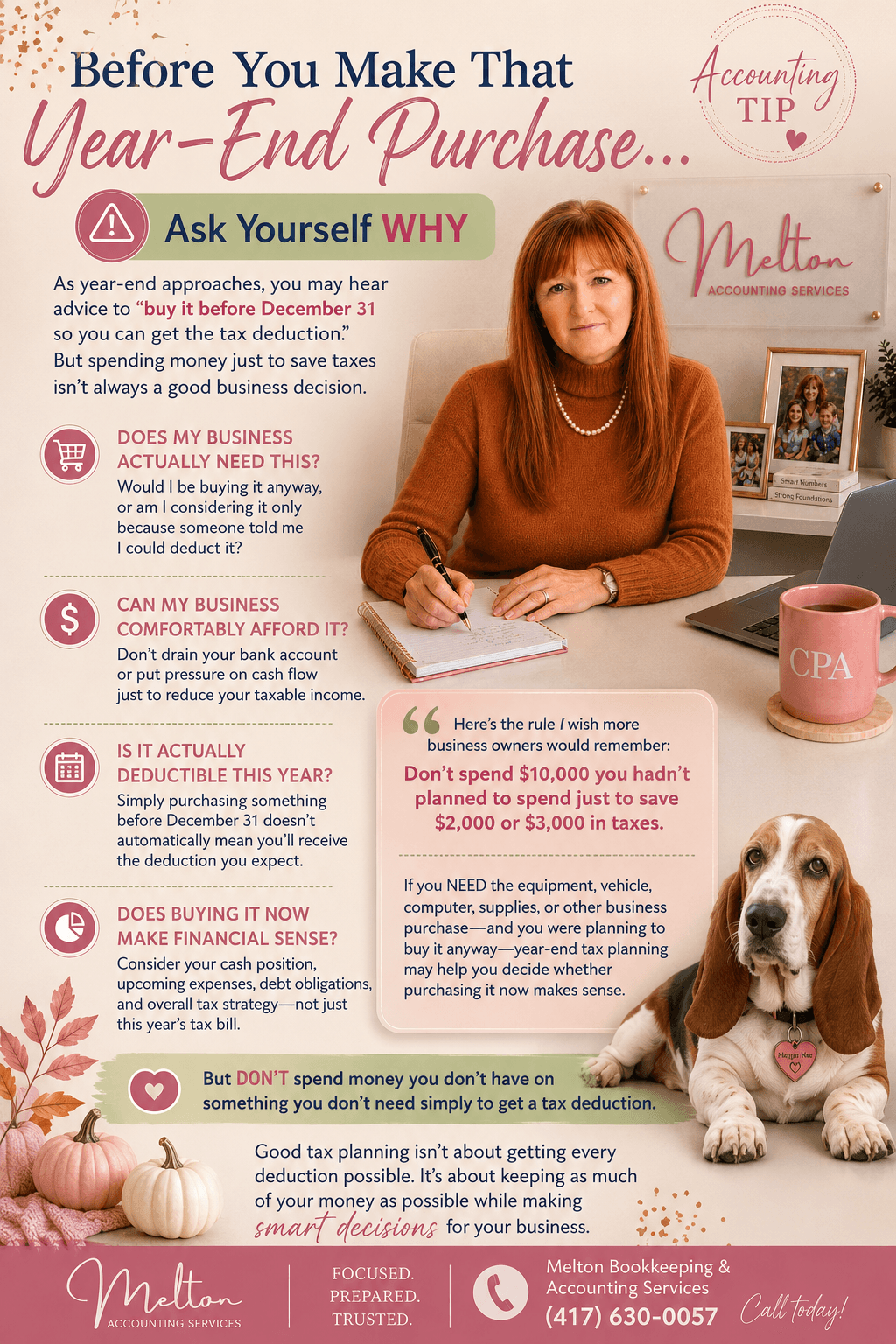
Before you spend money just to save on taxes, consider these four questions.
As the end of the year approaches, business owners start hearing a familiar piece of tax advice:
“Buy it before December 31 so you can get the tax deduction.”
Sometimes that can be good advice.
But sometimes it encourages business owners to spend money they don’t need to spend, on things they don’t really need, simply because they believe they’ll “get it back” on their taxes.
That’s not how a tax deduction works.
Should you make a year-end business purchase just to get a tax deduction?
Usually, no. A tax deduction reduces your taxable income; it doesn’t reimburse you dollar-for-dollar for what you spend.
If your business needs the purchase, can comfortably afford it, and buying it before year-end fits your overall financial and tax strategy, making the purchase now may make sense.
But spending money on something you don’t need simply to reduce your tax bill can leave your business with less cash overall.
Before making that year-end purchase, ask yourself one very important question:
Would I still buy this if there were no tax deduction?
If the answer is no, it may be time to reconsider.
A Tax Deduction Doesn’t Make a Purchase Free
This is one of the biggest misconceptions about business deductions.
A deduction generally reduces the amount of income subject to tax. It doesn’t reimburse you dollar-for-dollar for what you spent.
Let’s use a simple example.
Suppose you’re considering spending $10,000 on something for your business primarily because you want the deduction.
Even if that $10,000 purchase ultimately saves you $2,000 or $3,000 in taxes, you still had to spend $10,000 to get those tax savings.
You didn’t make $2,000 or $3,000. You spent $10,000.
If it’s equipment your business genuinely needs and you were planning to purchase it soon anyway, accelerating the purchase might make perfect sense.
But if you bought something you didn’t need simply to reduce your tax bill, you’ve traded $10,000 of cash for a much smaller amount of tax savings.
That’s not necessarily tax planning. Sometimes, it’s just spending.
Four Questions to Ask Before Making a Year-End Business Purchase
Before you start shopping because December 31 is approaching, consider these four questions.
1. Does My Business Actually Need the Purchase?
Start here. Would you be purchasing this equipment, vehicle, computer, furniture, software, supplies, or other item anyway?
Or did the purchase suddenly become appealing because someone told you that you could “write it off”?
There’s an important difference between: “We need this equipment, and we’re planning to buy it in January. Should we consider buying it in December instead?” and “We don’t really need anything, but I need some deductions. What can I buy?”
The first question may be good tax planning.
The second can lead to unnecessary spending.
2. Can My Business Afford the Purchase Without Hurting Cash Flow?
Your tax return isn’t the only thing that matters.
Cash flow matters, too.
Before making a significant year-end purchase, look beyond December 31 and consider what your business will need over the next several months.
Do you have payroll coming up? Payroll taxes? Sales tax? Insurance renewals? Loan payments? Vendor bills? A slower season ahead?
A tax deduction isn’t particularly helpful if the purchase leaves your business struggling to meet its obligations in January.
Be especially careful about taking on unnecessary debt simply to create a deduction.
Don’t spend money you don’t have just to save tax dollars.
Preserving healthy cash flow may be far more valuable to your business than squeezing another deduction into the current tax year.
3. Can I Deduct a Year-End Business Purchase on This Year’s Tax Return?
Don’t assume that buying something before December 31 automatically means you’ll receive the entire deduction on this year’s tax return.
Tax treatment depends on what you purchase and the applicable tax rules.
Some expenditures may be currently deductible, while others may need to be capitalized and depreciated. Special provisions may allow accelerated deductions for certain qualifying assets, while additional limitations can apply to vehicles and other property.
For depreciable property, when the asset is placed in service can also matter. Simply ordering or paying for something before December 31 doesn’t necessarily produce the tax result you expect if the property isn’t ready and available for business use.
That’s why a significant year-end purchase may warrant a conversation with your tax professional before you buy, not after.
You don’t want to make a large purchase based on an expected tax benefit only to discover later that the tax treatment isn’t what you assumed.
4. Does Making the Purchase Before Year-End Actually Make Financial Sense?
Tax consequences should be one factor in a business decision. They shouldn’t necessarily be the deciding factor. Consider the bigger financial picture.
Maybe buying equipment in December makes sense because your existing equipment needs replacing, you have adequate cash reserves, the new equipment will improve productivity, and purchasing it now provides a legitimate tax-planning opportunity.
Great.
But perhaps your existing equipment works perfectly well, cash flow will be tight during the first quarter, and you’re only considering the purchase because you’re worried about your tax bill.
Waiting might be the better business decision, even if it means paying a little more tax this year.
Paying Taxes Isn’t Always a Bad Thing
Nobody enjoys writing a large tax check.
But owing taxes usually means something else happened first: Your business made money.
The goal shouldn’t necessarily be to reduce taxable income as much as humanly possible.
The goal is to build a profitable, financially healthy business while taking advantage of legitimate tax-planning opportunities when they make sense.
There’s a big difference between avoiding unnecessary taxes and creating unnecessary expenses to avoid taxes.
I’d rather see a business owner pay tax on money the business earned than unnecessarily spend that money simply because December 31 is approaching.
Good Year-End Tax Planning Looks at More Than December 31
Year-end tax planning shouldn’t begin with:
“What can I buy?”
A better year-end conversation includes questions such as:
- What does taxable income appear to be so far?
- What estimated tax payments have already been made?
- What does cash flow look like heading into the new year?
- Are there legitimate purchases the business needs?
- Are there retirement planning opportunities to consider?
- Are there receivables, payables, payroll, or other timing issues that need attention?
- Are the books accurate enough to make good tax-planning decisions in the first place?
That last question is particularly important.
You can’t make good year-end tax decisions using books that aren’t accurate and up to date.
Your bookkeeping provides the starting point for meaningful tax planning. If income is missing, expenses are duplicated, accounts aren’t reconciled, or transactions have been categorized incorrectly, you’re trying to make tax decisions using unreliable information. Before deciding how much you need to spend to reduce your taxable income, make sure you know what your taxable income is likely to be.
Frequently Asked Questions About Year-End Business Purchases
Should I buy something for my business just to get a tax deduction?
Generally, no. A tax deduction generally reduces taxable income; it doesn’t reimburse you for the entire purchase. The purchase should first make sense for your business financially and operationally.
Is it better to spend money or pay taxes?
Spending $10,000 solely to save $2,000 or $3,000 in taxes still leaves you with substantially less cash.
Sometimes paying the tax and keeping the remaining cash is the better financial decision.
If I buy business equipment before December 31 can I deduct it this year?
Timing depends on the type of purchase and the applicable tax rules. For depreciable business property, when the asset is placed in service is important, not simply when you order or pay for it.
If you’re considering a significant purchase primarily because of its anticipated tax benefits, discuss the timing with your tax professional before making the purchase.
Can I deduct a vehicle I buy for my business at year-end?
Possibly, but vehicles are subject to additional tax rules and limitations. The available deduction can depend on factors including the type and cost of the vehicle, the percentage of qualified business use, the applicable depreciation rules, and when the vehicle is placed in service.
Don’t purchase a vehicle based solely on an assumed tax deduction without discussing your specific situation with your tax professional.
What should I consider before making a large year-end business purchase?
Ask whether your business genuinely needs the purchase, whether you can comfortably afford it, how it will affect cash flow, what tax treatment applies, and whether purchasing it now fits your overall financial and tax strategy.
The Bottom Line
Don’t make a year-end business purchase simply because you want a tax deduction.
If you need the item, can comfortably afford it, and buying it now fits your overall tax strategy, a year-end purchase may make sense.
But remember:
Don’t spend $10,000 you hadn’t planned to spend just to save $2,000 or $3,000 in taxes.
And definitely don’t spend money you don’t have on something you don’t need simply because someone told you it would lower your tax bill.
Good tax planning isn’t about getting every deduction possible.
It’s about keeping as much of your money as possible while making smart decisions for your business.
Start Year-End Planning With Accurate Books
Before you can make good decisions about purchases, taxes, cash flow, and the year ahead, you need to know where your business actually stands.
If your bookkeeping is behind or you’re not confident your financial statements are accurate, let’s get your books organized and tax-ready before year-end.
Call Melton Bookkeeping & Accounting Services at (417) 630-0057 today.
Tax laws and individual circumstances vary. This article provides general educational information and isn’t intended as tax advice for a specific taxpayer. Consult your tax professional regarding your individual circumstances.