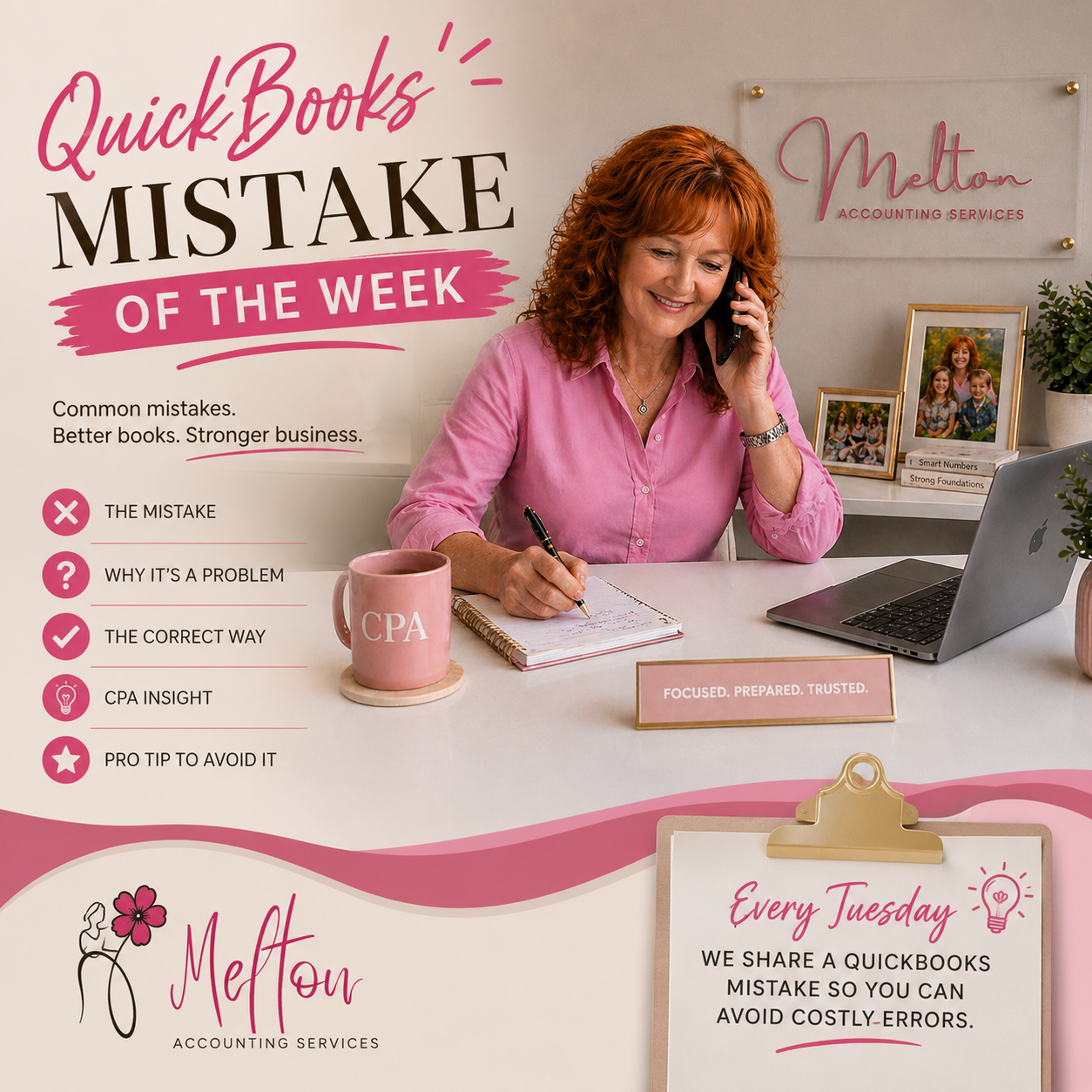
Many small business owners believe that if their bank accounts are connected to QuickBooks Online, their bookkeeping must be accurate. Unfortunately, that’s one of the most common bookkeeping mistakes I see.
While QuickBooks bank feeds are an excellent time-saving tool, they don’t verify that your accounting records are complete or correct. They simply import transactions.
The only way to confirm that your books accurately reflect what’s happened in your business is to reconcile your bank and credit card accounts every month.
Whether you’re a contractor, attorney, dentist, real estate investor, or another small business owner, monthly bank reconciliations are one of the best ways to protect your business, improve your financial reporting, and avoid costly mistakes.
❌ The Most Common Bookkeeping Mistake
Many business owners import transactions through QuickBooks bank feeds, categorize them, or accept QBO suggested categories, and assume their bookkeeping is complete. Others reconcile only at year-end when it’s time to prepare their tax return.
Unfortunately, this approach can lead to problems such as duplicate deposits, missing deposits, duplicate expenses, missing expenses, incorrect transaction categories, unrecorded bank fees or interest, credit card payments recorded incorrectly, expenses recorded in both the bank account and in a credit card account, bank errors that go unnoticed, and fraudulent transactions that aren’t discovered promptly.
Everything may appear correct on the surface while significant errors exist behind the scenes.
⚠️ Why This Causes Problems
Skipping monthly reconciliations affects much more than your bank balance.
Your financial reports become unreliable. If your bank account doesn’t reconcile, your Profit & Loss Statement and Balance Sheet may also be inaccurate. That means you’re making business decisions using information you can’t fully trust.
Cash flow becomes misleading. Many business owners look only at their bank balance. But if transactions have been duplicated or omitted, you may believe you have more, or less, cash available than you actually do.
Tax preparation becomes more difficult. When accounts haven’t been reconciled throughout the year, someone has to investigate months of transactions before an accurate tax return can be prepared. That often results in additional accounting fees and unnecessary stress.
Small mistakes become expensive mistakes. One incorrect transaction this month can snowball into dozens of errors by year-end. The longer problems remain undiscovered, the more time and expense it typically takes to correct them.
Fraud and bank errors may go undetected. Reconciling your accounts each month gives you an opportunity to identify unauthorized transactions, duplicate charges, and bank errors while they can still be addressed.
✅ The Correct Way to Handle It
Reconciling your accounts should be part of your monthly bookkeeping process, not an annual cleanup project.
Each month you should reconcile every bank account, reconcile every business credit card, compare the ending balances in QuickBooks with your bank and credit card statements, investigate every difference until the accounts balance, correct duplicate or missing transactions, review outstanding checks and deposits, and complete your reconciliations before relying on your monthly financial reports.
Just as importantly… Don’t stop once QuickBooks says the reconciliation is complete. Always review the reconciliation report to make sure the outstanding items actually make sense.
💡 A CPA’s Insight: Reconciling Is More Than Making the Numbers Match
Many people believe reconciling simply means clicking “Finish” once QuickBooks reaches a zero difference. That’s only part of the process.
A bank reconciliation is one of the strongest internal controls in small business bookkeeping and accounting. Its purpose is to independently verify that your accounting records agree with an outside source, your bank or credit card statement. Think of your bank statement as an independent report card for your bookkeeping.
Every reconciliation confirms that every transaction was recorded, nothing was recorded twice, your cash balance is accurate, and your financial statements can be trusted.
Professional accountants don’t prepare financial statements first and reconcile later. We reconcile first because accurate financial reports begin with accurate reconciliations. But even after the reconciliation balances… I always review the reconciliation report itself.
That’s often where the real story is hiding.
📖 A Real-Life Example: How Three Outstanding Deposits Revealed a Major Error
A few years ago, I took on a new bookkeeping client in the month of July.
Their prior year’s tax return had already been prepared and filed, and my first responsibility was to review their QuickBooks Online file before taking over the monthly bookkeeping.
As I completed the July 31 bank reconciliation, something immediately caught my attention. The reconciliation report showed three outstanding deposits totaling approximately $300,000. The amounts were significant. More importantly… They were all dated in the previous year.
That didn’t make sense.
Outstanding checks can remain uncleared for weeks or even months. Outstanding deposits should not. Once a deposit reaches the bank, it typically clears within a day or two. So I started investigating.
I discovered that each deposit had actually been entered twice. The customer payments had first been recorded correctly into Undeposited Funds. Later, instead of recording the actual bank deposit from Undeposited Funds, someone posted new deposits from the bank feed and recorded them directly to a Sales account.
The result?
The company’s revenue had been overstated by approximately $300,000.
To correct the error, we reopened the prior year’s books, removed the duplicate sales entries, and properly recorded the bank deposits from Undeposited Funds. Because the correction significantly reduced the company’s taxable income, we amended the previously filed tax return. The corrected bookkeeping reduced the client’s tax liability by approximately $117,000.
None of this would have been discovered if we had simply completed the July reconciliation without reviewing the reconciliation report.
✔️ Key Takeaways
Reconciling your accounts every month is essential. Reviewing the reconciliation report is equally important.
Ask yourself:
Do these outstanding checks make sense?
Why is this deposit still outstanding?
Has something been entered twice?
Is there a transaction that deserves further investigation?
Your reconciliation report is more than a bookkeeping formality. It’s one of the best tools available for identifying errors before they affect your financial statements, your tax return, or your business decisions.
❓ Frequently Asked Questions
Do I need to reconcile my bank account if I use QuickBooks Online?
Yes. QuickBooks imports transactions through bank feeds, but it does not verify that every transaction is complete, accurate, or recorded only once. Monthly reconciliations confirm that your books match your bank records.
How often should I reconcile my bank and credit card accounts?
At a minimum, every month after you receive your bank and credit card statements.
What happens if my bank account doesn’t reconcile?
A difference usually indicates missing transactions, duplicate entries, incorrect amounts, or posting errors. Those issues should be investigated before relying on your financial reports.
Why are outstanding deposits a red flag?
Outstanding deposits should generally clear the bank within a day or two. Deposits that remain outstanding for weeks or months often indicate duplicate entries, incorrect recording, or other bookkeeping errors that need to be investigated.
Can a CPA help clean up unreconciled QuickBooks accounts?
Absolutely. A CPA or experienced bookkeeper can identify bank reconciliation problems, correct accounting errors, clean up your QuickBooks Online file, and ensure your financial statements accurately reflect your business.
How Melton Bookkeeping & Accounting Services Can Help
At Melton Bookkeeping & Accounting Services, monthly bank and credit card reconciliations are a standard part of every bookkeeping engagement.
But we don’t stop once QuickBooks says, “Reconciliation Complete.”
We review reconciliation reports, investigate unusual items, and make sure your financial statements are accurate, reliable, and tax-ready.
Whether you need a QuickBooks Online cleanup, ongoing monthly bookkeeping services, or help understanding your financial reports, we’re here to help.
We proudly serve small businesses throughout Marshfield, Springfield, and Southwest Missouri, providing professional bookkeeping and accounting services designed to give business owners confidence in their numbers.
Ready for accurate, reconciled books? Contact us today to schedule a consultation and learn how our monthly bookkeeping services can help keep your business organized, informed, and prepared for tax season.